
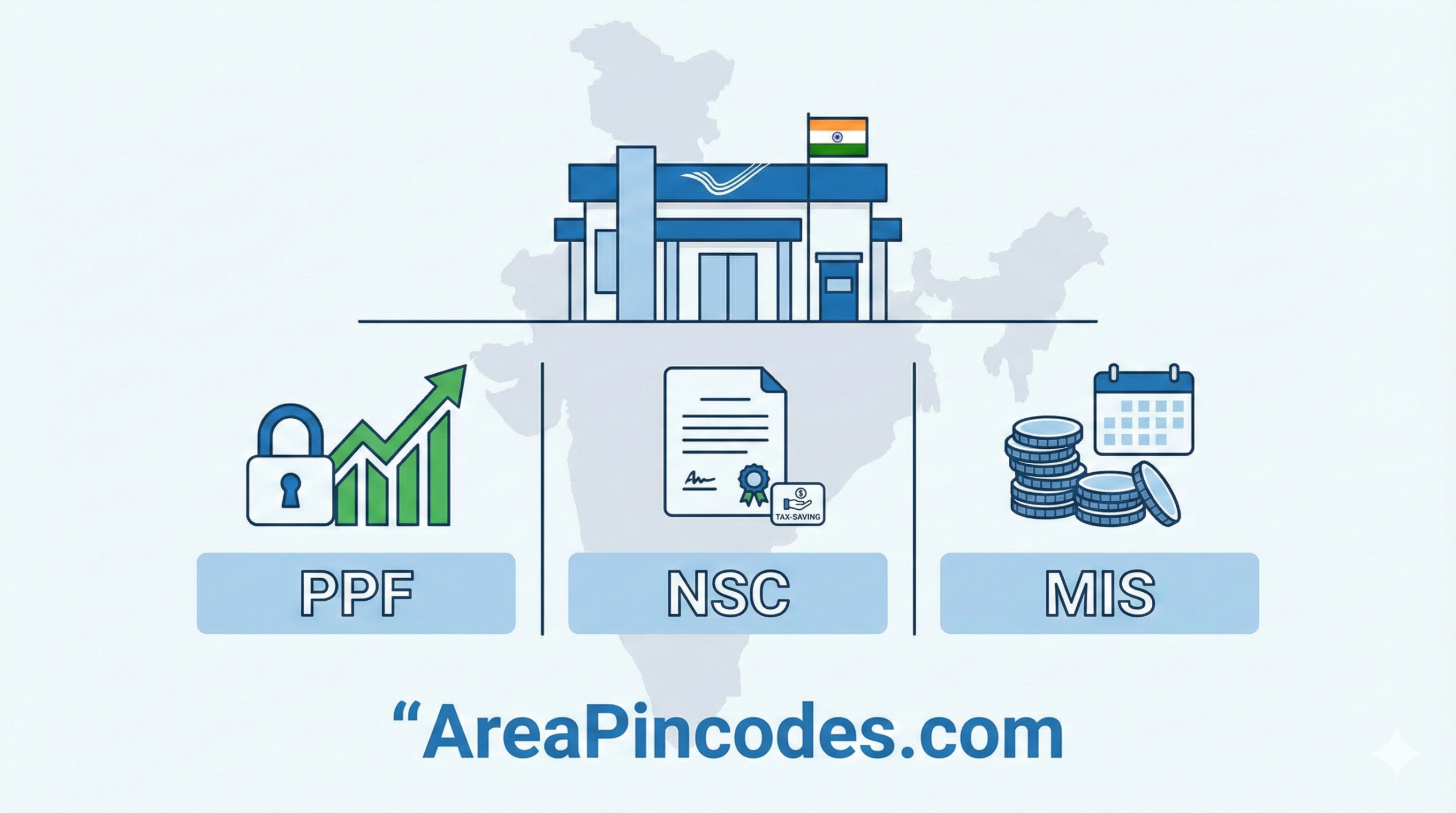
When it comes to safe and government-backed investments in India, post office savings schemes continue to be a top choice for millions of people. Among the most popular options are Public Provident Fund (PPF), National Savings Certificate (NSC), and Post Office Monthly Income Scheme (MIS).
Each of these schemes serves a different financial goal—long-term wealth creation, tax saving, or regular monthly income. However, many investors struggle to understand which scheme is best for their needs.
In this detailed guide, we will compare PPF vs NSC vs MIS across parameters like returns, lock-in period, tax benefits, liquidity, and suitability. By the end of this article, you’ll be able to make an informed decision based on your financial goals.
Why Choose Post Office Investment Schemes?
Before comparing the schemes, it’s important to understand why post office investments remain popular even in 2026.
- 100% Government-backed security
- Stable and predictable returns
- Widely accessible across India
- Ideal for conservative and medium-risk investors
- Simple rules and transparent structure
Post office schemes are especially suitable for retirees, salaried individuals, self-employed professionals, and first-time investors.
Overview of the Three Schemes
| Scheme | Best For | Investment Type |
|---|---|---|
| PPF | Long-term wealth & retirement | Long-term savings |
| NSC | Tax saving with fixed returns | Medium-term deposit |
| MIS | Regular monthly income | Income scheme |
Let’s explore each scheme in detail.
1. Public Provident Fund (PPF)
What is PPF?
The Public Provident Fund (PPF) is a long-term savings scheme introduced by the Government of India to encourage disciplined retirement savings.
Key Features of PPF
- Tenure: 15 years (extendable in blocks of 5 years)
- Minimum investment: ₹500 per year
- Maximum investment: ₹1.5 lakh per year
- Interest rate: Government-declared (compounded annually)
- Risk level: Very low
Tax Benefits
PPF offers EEE tax benefits:
- Investment eligible under Section 80C
- Interest earned is tax-free
- Maturity amount is tax-free
Liquidity & Withdrawals
- Partial withdrawals allowed after 6th year
- Loan facility available after 3rd year
- Full withdrawal only after maturity
Who Should Choose PPF?
PPF is ideal for:
- Salaried employees
- Young professionals
- Long-term investors
- Retirement planning
- Parents saving for children’s future
2. National Savings Certificate (NSC)
What is NSC?
The National Savings Certificate (NSC) is a fixed-income investment scheme mainly used for tax saving with guaranteed returns.
Key Features of NSC
- Tenure: 5 years
- Minimum investment: ₹1,000
- Maximum investment: No upper limit
- Interest rate: Fixed at the time of investment
- Compounding: Annually (paid at maturity)
Tax Benefits
- Investment qualifies under Section 80C
- Interest earned is taxable
- However, interest for the first 4 years is treated as reinvested and qualifies for 80C
Liquidity & Withdrawals
- No premature withdrawal (except death or court order)
- No loan facility
- Best held till maturity
Who Should Choose NSC?
NSC is suitable for:
- Tax-saving investors
- Risk-averse individuals
- People with 5-year financial goals
- Those who prefer fixed returns
3. Post Office Monthly Income Scheme (MIS)
What is MIS?
The Post Office Monthly Income Scheme (MIS) is designed for investors who need steady monthly income from a lump-sum investment.
Key Features of MIS
- Tenure: 5 years
- Minimum investment: ₹1,000
- Maximum investment: ₹4.5 lakh (single), ₹9 lakh (joint)
- Interest payout: Monthly
- Risk level: Very low
Tax Benefits
- No Section 80C benefit
- Monthly interest is taxable
- Suitable for income rather than tax saving
Liquidity & Withdrawals
- Premature withdrawal allowed after 1 year with penalty
- Capital returned at maturity
Who Should Choose MIS?
MIS is best for:
- Senior citizens
- Retired individuals
- Housewives
- People seeking stable monthly income
PPF vs NSC vs MIS: Detailed Comparison
| Feature | PPF | NSC | MIS |
|---|---|---|---|
| Investment Goal | Wealth creation | Tax saving | Monthly income |
| Lock-in Period | 15 years | 5 years | 5 years |
| Interest Type | Compounded | Compounded | Monthly payout |
| Tax on Interest | Tax-free | Taxable | Taxable |
| Section 80C Benefit | Yes | Yes | No |
| Risk Level | Very low | Very low | Very low |
| Liquidity | Partial | No | Limited |
Which Scheme Is Best for You?
Choose PPF If:
- You want long-term tax-free wealth
- You are planning for retirement
- You can invest annually for many years
Choose NSC If:
- You need safe tax-saving investment
- Your horizon is 5 years
- You want guaranteed returns
Choose MIS If:
- You want monthly income
- You are retired or near retirement
- You have surplus lump-sum funds
Can You Invest in All Three?
Yes. Many investors use a combination strategy:
- PPF for long-term retirement
- NSC for medium-term tax saving
- MIS for monthly cash flow
Diversifying across schemes helps balance liquidity, income, and growth.
Things to Check Before Investing
- Confirm the correct PIN code of the post office
- Carry valid KYC documents
- Check latest interest rates
- Understand tax implications
- Match the scheme with your goal, not just returns
You can use AreaPincodes.com to find accurate post office PIN codes and location details before visiting.
Final Verdict
There is no single “best” scheme among PPF, NSC, and MIS. The right choice depends on:
- Your age
- Income stability
- Financial goals
- Tax planning needs
If you want long-term, tax-free growth, choose PPF.
If you want safe tax saving for 5 years, choose NSC.
If you want steady monthly income, choose MIS.
Post office schemes remain one of the safest investment options in India, especially for conservative investors.